


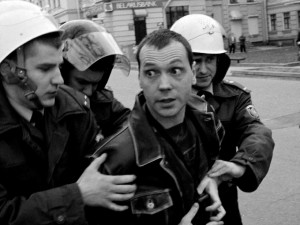
A representative of Amnesty International met with prisoner of conscience, Maxim Dashuk, in September 2010. Maxim described how difficult it’s been to live under ‘restricted freedom’ following his sentence in May 2008, at the age of 17.

Belarus President Lukashenka has one more reason to be angry. His friend and business partner Yuri Luzhkov is no longer the Mayor of Moscow.

https://belarusdigest.com/story/the-more-enemies-the-better/

Last week, official results of the last, 2009 national census were released. Population of Belarus decreased from 10 million (1999) to 9.5 million (5.4% during 10 years). It was caused by falling birth rates and population in general is getting ever older. Thus, average age of Belarusians increased from 37.1 to 39.5 years. Such trends are rather common for European countries.

On September 15, international human rights watchdog has written to the Prosecutor General of Belarus calling for a prompt, impartial and effective investigation into the recent death of Aleh Byabenin. Bellow we present full text of the statement.

On September 14, Belarusian Chamber of Representatives has set the date of the presidential election in the country. All present 108 MPs unanimously voted for this date.

Mike Harris from Index on Censorship went to Minsk in the beginning of September to meet Belarusian civil society activists including journalist Aleh Byabenin. It had never happened. One of the founders and a leader of charter97.org website had been found hanged in his summer cottage. In his article for The Independent * Mike Harris reflects on the death of his colleague and the political climate of Lukashenka’s Belarus. Europe’s shame: the dictatorship of Belarus A death in Minsk should sound the alarm bells By Mike Harris The Independent Wednesday, 8 September 2010 I landed in Minsk, the capital of Belarus, last Friday to meet the journalist Oleg Bebenin and other civil society activists. On Monday I attended Oleg’s funeral. One of Belarus’s leading journalists, he had been found hanged in his country home earlier on Friday. His beloved 5 year old son’s hammock was around his neck, hung so low that his feet touched the ground. Andrei Sannikov, of the human rights group Charter97, the organisation Bebenin co-founded, was one of the first at the scene. He has grave doubts about the coroner’s suicide verdict. “No suicide note was found, and his last SMS to friends showed they planned to go to the cinema.”

While some analysts are calculating whether the West/Europe can agree with Russian plans to change Belarusian regime or has already done so, there are reasons to assume another tacit deal. Between Western political leadership and Lukashenka. Without much noise, Western attitude to Belarus changed regarding the most important for Minsk point. Both EU and the US have given up their policies aimed at removing Lukashenka. There were no official statements, of course. But relations between Belarus and EU (to a lesser extent also relations with the US) are drifting towards normality. Though this year brought no highest level visits but there are numerous contacts between officials which demonstrate a tendency to renounce earlier confrontation altogether. Thus, at the end of the recent visit by Czech senators to Minsk, one of them, Deputy Chairman of Foreign Affairs, Defense and Security Committee Tomáš Jirsa said, I am leaving with the opinion that also in the future there are no problems for Czech Republic to support Belarus either in the framework of bilateral relations or at the EU level.* But that is nothing compared with another development concerning Western support for Belarusian opposition. These days, Belarusian political community accepted the sheer fact that at the near presidential elections there will be one candidate which is explicitly pro-Russian. The candidate from previous 2006 elections – Alyaksandar Milinkevich – did not manage to find money from the West this time.

Belarus is about to sign the world’s largest sale of fighter jets to a private company. ECA, a Netherlands-based company, is in talks to purchase 33 fighter jets from BelTechExport, a state-onwed Belarusian company. ECA plans to use the jets in Iceland as a mock enemy in military training exercises. The size of the deal is impressive – 33 fighter jets would be enough to fully equip army of a mid-sized European country. According to Financial Times: ECA has agreed to buy 15 Sukhoi Su-27 “Flanker” jets from BelTechExport, a Belarusian arms export company, with the option of 18 more. If completed, it would be the biggest sale of fighter aircraft to a private buyer and the first large-scale import of Russian-made warplanes into a Nato country. … the aircraft were originally made in Russia and will be “upgraded” in Belarus, with the first delivery in October. Belarus is already one of the world’s largest military exporters. Although the country does not manufacture significant quantities of military equipment, it has old Soviet stocks and significant imports from Russia. In addition, 558 Aviation Repair Plant* is located near Baranavichy, in Western Belarus. The plant has wide experience of military technical collaboration with the foreign countries, and specializes in upgrading Soviet fighter jets.
Aleh Byabenin was one of the founders and leaders of charter97.org website. According to the Belarusian independent news portal charter97.org *, the body of Aleh Byabenin was found on September 3, at 5.30 p.m. in his summer cottage not far from Minsk. The reason of death is not clear.

It is hardly a secret that establishing diplomatic relations with an authoritarian state is a gamble. One never knows what one’s embassy in Minsk may suffer if it crosses swords with the Belarusian President Alyaksandr Lukashenka.

Belarus and Ukraine are celebrating the 19th year of their independence in 2010. Kiev decided to schedule the fireworks for August 24. On this day in 1991, spurred by the “mortal danger surrounding Ukraine” after the USSR August coup, the Ukrainian Rada passed the Act of Declaration of Independence. Back in 1991, Belarusian parliamentarians followed Ukraine’s example. The very next day, they gave the status of a constitutional law to the Declaration of Belarusian State Sovereignty, adopted on July 27, 1990. But today, Minsk celebrates neither August 25th nor July 27th. The authorities don’t even commemorate the creation of the Belarusian People’s Republic on March 25th, 1918. Instead, independence day celebrations are held on July 3rd, the date marking the liberation of Minsk from the Nazi troops in 1944. Whatever the wisdom of choosing one or the other date to commemorate, one can’t help comparing the goals of Belarusian and Ukrainian policymakers expressed 19 years ago and as their successes in actualizing these goals. In fact, the differences in Minsk’s and Kiev’s interpretations of independence and sovereignty date back to 1990, when the Soviet Union still existed. One need only compare the two states’ respective Declarations of State Sovereignty, passed in the same political environment by the national parliaments of Belarus and Ukraine within a day from each other. The two documents are similar in structure and in language, which makes their idiosyncrasies stand out even more.

Damon Wilson and David Kramer recently gave they account of how the United States pressure resulted in Belarus regime’s release of political prisoners. David Kramer was the key figure in George W Bush administration responsible for dealing with Belarus. It is interesting to see different approaches of the United States with their principled stand and the Realpolitik of Germany. According to Wilson and Kramer, the German embassy in Minsk was trying to strike a deal with Belarus authorities to let Alexander Kazulin, a former Belarus presidential candidate, quietly go into voluntary exile. Kazulin rejected that offer and was subsequently released without any conditions following the US pressure.